



































 By
By
Published: 23 April 2026 | Knowledge Hub: Safety & Tech
The Cloud Dilemma: Investigating Whether Vaping Can Trigger Fire Alarms
As the prevalence of electronic cigarettes continues to rise across the United Kingdom, a persistent question lingers in the minds of commuters, hotel guests, and office workers alike: "Can vaping trigger a fire alarm?" While many users assume that the lack of combustion makes their devices "safe" for indoor use, the scientific reality of how smoke detectors function suggests a more complex narrative.
Recent data indicates that a significant number of false fire alarms in public spaces are now attributed to high-density vapour clouds. This guide explores the mechanics behind vape smoke detectors, the different types of sensors you might encounter, and the legal implications of "stealth vaping" indoors.
How Modern Sensors Detect Your Vapour
To understand why a vape might trigger a smoke detector, one must first understand that most alarms do not actually "smell" smoke. Instead, they detect particles in the air. E-cigarette vapour consists of tiny liquid droplets of propylene glycol (PG), vegetable glycerine (VG), and flavourings. To a sensitive electronic sensor, these particles can be indistinguishable from the carbonaceous particles found in actual smoke.
According to safety experts at Vape London, the likelihood of an alarm sounding depends heavily on the technology used within the device. Below is a breakdown of how different alarms react to vapour:
| Alarm Type | Mechanism | Risk Level from Vaping |
|---|---|---|
| Optical (Photoelectric) | Uses light beams; triggers when particles scatter the light. | Very High |
| Ionisation | Uses radioactive isotopes to detect disrupted air flow. | Moderate |
| Heat Sensors | Reacts to sudden increases in temperature. | Very Low |
The Science of Optical Alarms
Optical alarms are the most common variety found in modern UK homes and hotels. They work by aiming a light source into a sensing chamber at an angle away from the sensor. When vape particles enter the chamber, they reflect the light onto the sensor, completing the circuit and triggering the siren. Because e-cigarette vapour is often denser than traditional tobacco smoke, it is particularly effective at scattering these light beams.
Why "Vaping Fire Alarm" Incidents are Increasing
The trend towards "Sub-Ohm" vaping—devices that produce massive, thick clouds—has exacerbated the issue. While a small "cigalike" or pod system might not produce enough particulate matter to trigger a sensor in a large room, high-powered mods can quickly fill a confined space like a bathroom or a small bedroom.
As noted in guidelines by Blu UK, while e-cigarettes do not produce the same lingering scent or tar as tobacco, the physical density of the aerosol is the primary culprit behind vape-triggered smoke detectors.
Legal and Social Consequences in the UK
It is crucial to recognise that while vaping is not illegal under the Health Act 2006 (which banned smoking in enclosed public places), individual establishments have the right to prohibit it. Triggering a fire alarm in a hotel or on a train can lead to:
- Hefty Fines: Many hotels charge a "deep cleaning" fee or a penalty for fire service call-outs.
- Eviction: You may be asked to leave the premises immediately without a refund.
- Legal Action: On public transport, such as the London Underground or national rail, triggering an alarm can lead to prosecution for "interference with safety equipment."
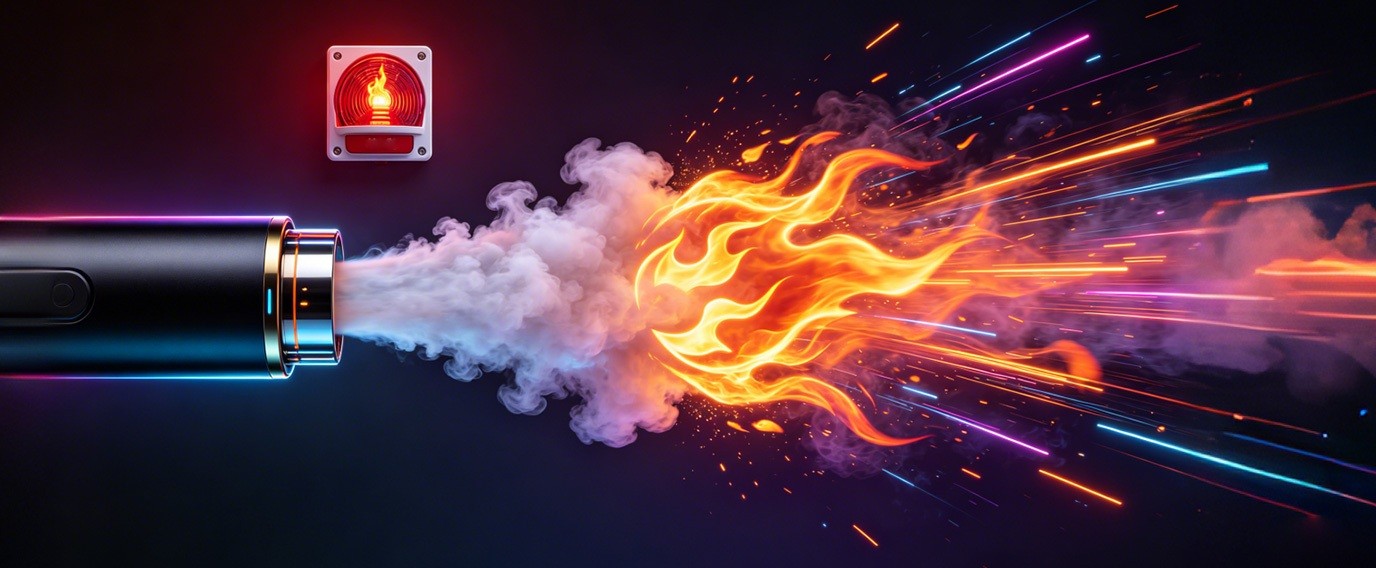
Infographic: The proximity of vapour clouds to ceiling-mounted sensors significantly impacts alarm triggers.
Frequently Asked Questions (FAQ)
1. Can a small pod system still set off an alarm?
Yes. Although they produce less vapour, if the vapour is blown directly into or near an optical sensor, it can still trigger the alarm.
2. Is it safe to vape in a hotel room?
Generally, no. Most UK hotels have strict non-smoking and non-vaping policies. Their sensitive optical sensors are specifically designed to detect any airborne interference.
3. Will vaping in the bathroom with the shower on prevent the alarm?
This is a common myth. Steam itself can actually trigger some smoke detectors, and adding vapour to the mix only increases the density of the air, making an alarm more likely.
4. Do aeroplanes have vape-specific detectors?
Aeroplane smoke detectors are incredibly sensitive and are designed to detect minute changes in air quality. Vaping in an aircraft toilet is almost guaranteed to trigger an alarm and lead to arrest.
5. Can I use a "disposable" vape near a fire alarm?
The type of device (disposable vs. refillable) doesn't matter; it is the vapour production that triggers the sensor. Disposables still emit VG/PG clouds that can scatter light in optical sensors.
6. Are there any alarms that are "vape-proof"?
Heat detectors are largely "vape-proof" as they don't react to particles. However, these are usually only found in kitchens. Most hallways and bedrooms use optical or ionisation sensors which are susceptible.
Disclaimer: This article is for informational purposes only. Always follow local laws and establishment policies regarding vaping. For more technical details on fire safety, consult the UK Government Fire Safety guidelines.